
This blog post has been waiting in the wings for a while, mostly completed but still in my drafts. Please forgive the long break between posts. Learning the ins and outs of a new grade level (5th grade after four years of middle school small-group literacy) has understandably been filling my days and I’ve been putting this on the back burner. It was high time I got this post published. Enjoy!
Now on to the good stuff. And by good, I mean nitty-gritty. And the nitty-gritty is good because – let me tell you – it is fascinating.
The sheer creativity of human language is one reason to love linguistics. When you realize that groups of people can communicate ideas in ways you never even considered before, you start to see why linguists (and amateur linguistics fans, such as myself) love delving into new grammars.
Here are a few of the things I’ve learned. Let’s get into it.

For this particular blog post, I’m choosing to focus on inflectional morphology. As you’ll recall, inflectional morphology is about marking words for grammar. Derivational morphology, on the other hand, is about making new words. English uses a lot of derivation but hardly any inflection. I think this is why I found inflectional morphology to be particularly interesting. There are only a few inflectional morphemes in English – in fact, you can count them on two hands! The usual list includes: -s/-es (plural), -s/-es (3rd person singular), -‘s/s’ (possessive), -ed, -en, -ing, -er, and -est. It’s kind of a shame that of the few inflectional affixes we have in English, at least three of them just sound like /s/.
In all of my literacy education studies so far – at Hamline University and also at professional development sessions at work – we have focused almost exclusively on derivational morphology. In fact, in my personal experience, “morphology” in a literacy education context is more or less synonymous with “derivational morphology.” (At least among teachers of English literacy as opposed to teachers of the English language.)
Knowing the ins and outs of derivational morphology is likely to be more productive for students, but understanding inflectional morphology really lets us understand how a language works. Almost all “big words” with derivational affixes (for example, “disillusionment”) can be expressed by series of smaller words. For “disillusionment” I would describe it as a state of realizing your ideas were not correct. It’s helpful to understand how to break down “disillusionment,” but this doesn’t compare with knowing that past tense verbs in English usually have “-ed” at the end while present continuous verbs have “-ing.” It’s apples and oranges. So, let’s revisit derivational morphology another time.
The following paragraphs (with a gray background) are excerpted and edited from the literature review of my capstone paper. Instead of rewriting everything, I went ahead and copied and pasted some paragraphs here, making a few revisions to make it more readable for a blog format. Some things have been deleted and others have been added. One notable formatting change is that I’ve removed the in-text citations (except for direct quotes) and put all references at the end of this post.
Marking Words for Grammar: Inflection
When “walk” changes to “walks,” this is an example of inflection. In English, third person singular pronouns require an “-s” or “-es” be added to their verbs. For example, for the verb “to go,” it is correct to say “I go,” “you go,” “we go,” “they go,” but “he goes.” Similarly, “I swim,” “you swim,” “we swim,” “they swim,” but “Jenny swims.”
It’s usually not necessary to inflect words in English for the sake of comprehension alone, as you can figure out a lot from context. You’re unlikely to struggle to understand the sentence, “Jenny swim in the pool every day,” even if it sounds a bit off. Some languages, such as Chinese, Vietnamese, and Hmong do very little to modify their words for grammar. These languages would not differentiate between “go/goes” or “swim/swims.” Other languages, such as Russian or Finnish, have complex and rigid expectations for grammatical marking.
Some of the most common grammatical categories (which may or may not require modification, depending on the language) include: number, case, gender, tense, aspect, mood, person, and degree. Some of these will be familiar to English speakers and others may be entirely novel.
Inflection of Nouns
Nouns are people, places, and things (including animals and abstract ideas). Examples of nouns include “bell peppers,” “Oslo,” “George Washington,” “democracy,” and “my parents’ dog Snowy.” Nouns like these can be marked (inflected) to show the grammatical categories of number, case, or gender.
Number: In English, there are two values for the category of number: singular and plural, and every word has to show one or the other. The sentence, “Look at that horse,” shows singularity by using “that” and not adding anything to the end of “horse.” Compare this with, “Look at those horses.” This new sentence shows plurality by using “those” and adding an “-s” to the end of “horse” to make “horses.’ However, we don’t know if there are two horses, a dozen, or five hundred. Number in English is limited to singular (one) and plural (more than one). In other languages, there might be more nuance. Some languages mark for dual (two), trial (three), or paucal (a few) number; others don’t have to mark for number at all, and amounts are left unspecified unless inflection is used; others may only mark number for living things or humans.
Pause of factoid. Did you know that apparently the Sursurunga language of Papua New Guinea has five grammatical values for number? (Hornsby, 2014). Not content with just singular and dual, this language also employs trial, quadral, and plural. One has to imagine that if you spoke Sursurunga, you’d become really good at recognizing groups of two, three, and four without much conscious effort. A quick check of this fact on Wikipedia leads me to believe this is mostly used for pronouns, but still! Papua New Guinea is known for its linguistic diversity and it is generally believed that there are 840 languages spoken within the country.
Case: Case doesn’t play a large role in English and it may be unfamiliar to native English speakers. Case shows a noun’s role in a sentence, whether it is doing the action as the subject, being acted upon as the object, or something else.
Imagine a mug, sitting on a kitchen table, ready to be used for one’s morning coffee. In the sentence, “The mug sits on the table,” “mug” is the subject of the sentence; it is doing the action of sitting. In the sentence, “I held the mug in my hands,” “mug” is now a direct object, being acted upon (“held”) by the subject (“I”). In the sentence, “I poured coffee into the mug,” the role of the mug has shifted yet again: it is now an indirect object, receiving the result of the action (coffee being poured.)
These different circumstances are called cases. In “The mug sits on the table,” mug is in the subjective case. In “I held the mug in my hands,” and “I poured coffee into the mug,” mug is in the objective case. Even when the mug’s role shifts from actor to directly acted upon to indirectly acted upon, the spelling and pronunciation of “mug” never changes. This might be taken for granted in English, but this is far from the case (no pun intended) in many of the world’s languages, including Hungarian, Polish, and Russian, just to name a few. In these languages, nouns can have dozens of word forms, depending on the role they play in a sentence.
In English, nouns are not inflected for case, with one notable exception: pronouns. English pronouns have retained different forms for the subjective and objective cases. A native English speaker knows instinctively to say, “I gave my friend a present,” but, “My friend gave a present to me.” Similarly, in a group, we’d say “We spoke with Jane,” but “Jane spoke with us.” Young children might mix up the subjective and objective cases in a sentence such as, “Me want milk.” Just like “Jenny swim in the pool every day,” this might sound weird, but it’s not actually difficult to understand.
Pause for anecdote. A wholly unexpected joy that came about from my study of grammar is that I was able to finally understand and appreciate the “Latin Lesson” scene from the Monty Python movie Life of Brian (aka: “Romans Go Home!) In this scene, our protagonist, Brian (played by Graham Chapman), sneaks out at night to graffiti the words “ROMANES EUNT DOMUS” (“Romans go home”) on a wall in Roman-occupied Judea. A Roman guard (John Cleese, portraying the wrath of some Latin teacher he no doubt encountered in boyhood) catches him in the act and is appalled at his poor grammar. Brian has apparently written something more akin to “People-called-Romanes they go the house.” The guard makes Brian work out how to say the sentence correctly using the proper conjugations (for the verbs) and declensions (for the nouns). He is then ordered to copy it a hundred times before sunrise.
It was the nerdiest thing, but I really laughed out loud when I heard these lines:
Guard: “Domus? Nominative? Go home? This is motion towards, isn’t it, boy?”
Brain: “Dative?”
The guard unsheathes his sword and holds it up to Brian’s neck.
Brian: “Agh! No dative, not the dative, sir! No! Ahh! The accusative, accusative. Ahh! Domum, sir, ad domum.”
Guard: “Except that domus takes the…?”
Brian, “The locative!”
Guard: “Which is…?”
Brian: “Domum!”
Guard: “Domund. Understand?”
Brian: “Yes, sir.”
Guard: “Now write it out a hundred times.”
(Monty Python, 1975)
I don’t know Latin and I certainly can’t tell you the details of how inflectional morphology works in this ancient language. But the idea of being under pressure to come up with the correct translation is something any language learner can relate to!
I’m not going to link a video of this scene, as it doesn’t appear that Monty Python has posted this one from their official YouTube channel. However, it is easily found online. One can even watch a full Latin lesson going over the details of the scene!
Gender: Gender is hard to define, because it “does not seem to serve any obvious linguistic purpose in the way that number or tense, for example, do” (Hornsby, 2014, p. 126). Because gender values and markings are so diverse across languages as to be relatively meaningless, some linguists use the term “noun classification” instead of “gender”.
Across the world’s languages, gender values (i.e. noun classes) are broad, and include the combined masculine and feminine (common gender), neuter, personal nouns, trees and plants, the names of languages, animate objects, and inanimate objects, just to name a few. It is interesting to note that the word “gender” comes from the Old French “genre” and originally was more akin in meaning to “kind,” “sort,” or “character”.
Gender in English is only consistently used for third person singular pronouns, where “he/him” is used for an animate male entity and “she/her” is used for an animate female entity. Additionally, “they/them” may be used for animate entities of unspecified gender while “it/its” is used for inanimate or non-living entities. Other examples of gender in English include some occupational nouns, for example “actor” versus “actress,” or the addressing ships and nations as female, but these aren’t required for comprehension.
Inflection of Verbs
Verbs are action words such as “make,” “reach,” “think,” “run,” and “do.” In English, the infinitive form of a verb is expressed with the word “to” in front of it (e.g. “to make,” “to reach,” “to think,” etc.). Although a majority of verbs are conjugated according to consistent rules in English, some, such as “to be” or “to have,” follow different rules. “Being” and “having” are essential parts of expressing ourselves as humans and both verbs trace their roots back to Proto-Indo-European. Verbs such as these are extremely old and may act differently than other verbs based on their staying power in English. Other unique verbs include the modals, such as “might,” “could,” and “will.”
Tense: Tense shows if an event is happening in the past, present, or future. In English, verbs are inflected for the past tense (“I rented a bicycle,”) but not the future tense (“I will rent a bicycle,”) instead using the auxiliary modal verb “will” for this purpose. This is not the case in other languages, including Spanish and French, where future tense is indicated by specific affixes.
Mood: Grammatical mood gives nuance how to communication about reality, whether something that is real, might be real, or should be real – in other words, “the actuality of an event,” Grammatical moods include the indicative, subjunctive, and imperative, among others.
The indicative is used with actions reported in a real and factual way, such as “He took the bus downtown.” The subjunctive is used with events which are not real but which show the speaker’s “hoping, ordering, or claiming” (Booij, 2012, p. 140), for example, “I wouldn’t do that if I were you,” or “Please be careful.” The imperative mood is used for giving commands, such as, “Go to your room!” or “Let’s get dinner sometime.”
One more grammatical mood is the conditional, which is used with events that could be real, for example, “She would play the piano if she had time.” In English, we do not inflect verbs to show the conditional, but instead use the auxiliary modal verb “would.”
Aspect: Grammatical mood provides nuance around the reality of events, but grammatical aspect provides nuance around the completion of events. Booij (2012) defines two of the most common forms: “Perfective aspect presents situations as completed, whereas imperfective aspect presents the situation as ongoing” (p. 138). The imperfective aspect, sometimes also called the progressive, includes events that happen regularly, habitually, or are currently underway.
Below, a table from Celce-Murcia and Larsen-Freeman’s “The grammar book” (1990, p. 110) has been recreated with light editing. Using the verb “to write” as an example, the ways in which tense and aspect interact with each other are demonstrated.
| Simple | Perfect | Progressive | Perfect Progressive | |
| Present | write/writes | has/have written | am/is/are writing | has/have been writing |
| Past | wrote | had written | was/were writing | had been writing |
| Future | will write | will have written | will be writing | will have been writing |
Note that although twelve different tense and aspect combinations are presented in the table above, to write only has five different word forms: “write,” “writes,” “writing,” “wrote,” and “written”. Instead, English accomplishes the task of showing tense and aspect by using the auxiliary verbs “to have” and “to be,” as well as the modal verb “will”. This demonstrates how English tends to favor analytic morphology (using additional words to build meaning) over synthetic morphology (internally modifying the words themselves).
Inflection of Adjectives
In English, adjectives can be modified to show degrees of comparison. The comparative suffix “-er” and the superlative suffix “-est” (for example, “small”/“smaller”/“smallest”) show different degrees of comparison. Inflecting adjectives in this way is not very common among the word’s languages and ELL students may need direct instruction in how these suffixes work.
For another perspective on this, I’d recommend the video Fantastic Features We Don’t Have in the English Language from Tom Scott. (Really, I’d recommend all of his videos about language and linguistics. I’ll go one further: I recommend his channel in general. He’s a wonderful public-facing communicator, educator, and all-around charismatic nerd.)
Most monolingual speakers think that other languages are basically just their language with different words in a slightly different order and maybe a different way of writing. Turns out, though, that there are lots of interesting features in other languages, some of which English could really benefit from having.
Tom Scott (2013).
Fantastic Features We Don’t Have In The English Language
At the one-minute mark of the video, Tom talks about a feature of some languages called clusivity. This is a language feature I got to learn about firsthand when living in Indonesia. Although I never became fluent in Bahasa Indonesia, I managed to learn enough to exchange pleasantries, order food at a restaurant, and direct a taxi back to my apartment.
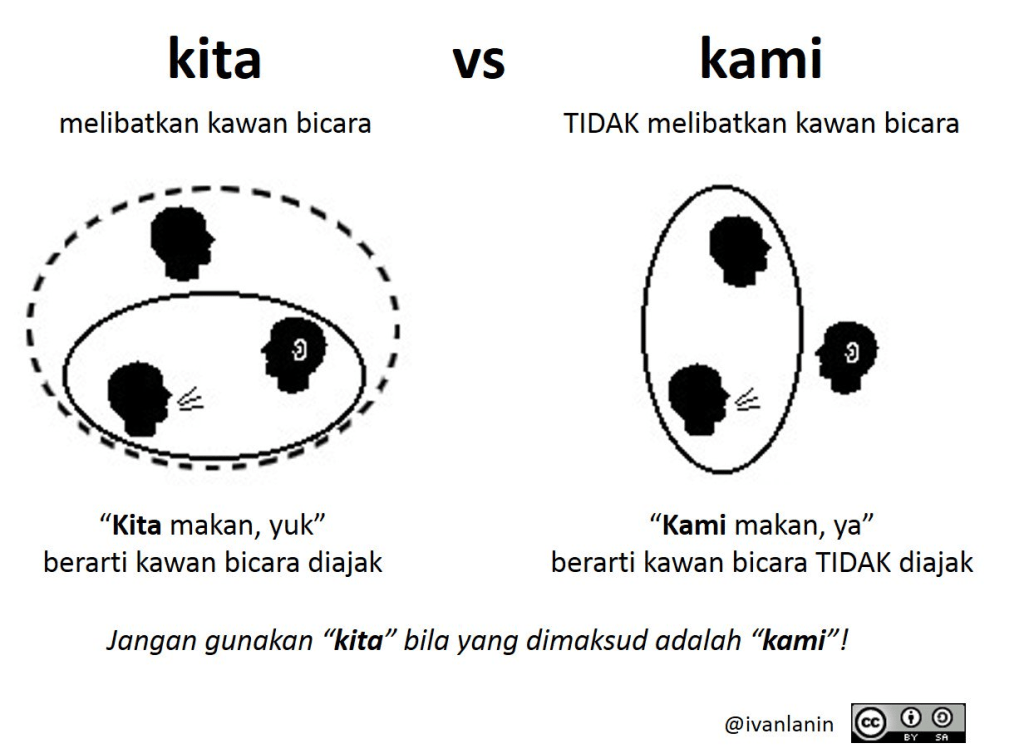
The first pronoun I learned in Indonesian was “saya” which does the job of both the English words “I” and “me.” If one Indonesian word does the job of two English ones when it comes to first-person singular, you might expect the same to be case for first-person plural (“we” and “us.”) As it turns out, there are two first-person plural pronouns in Indonesian, but they don’t reflect a subject/object contrast like “we” (subjective case) and “us” (objective case) do. Instead, they show if the listener is included in the “we” or not. If the listener is included in the “we”/”us,” then the Indonesian word “kita,” is used. If the listener is excluded, then “kami,” will be used. This is linguistic feature of clusivity.
The way I memorized the difference between “kami” and “kita” was by connecting it to my French knowledge. In French (as in English) many first-person pronouns have the letter “m” in them, as in “moi,” or “me.” This made me think that “kami” was about me but not about you (the listener). However, many second-person pronouns in French have the letter “t” in them, as in “tu,” “toi,” or “te.” This made me think that “kita” was about you and me both.
An example pulled from X (Twitter) user Ivan Lanin nicely shows the difference between “kita” and “kami”. In the example on the left, the speaker says “kita makan,” which means “Let’s go eat,” and includes the listener, as in “Hey, Gary and I are going to grab a bite. Come with us!” On the right, however, the speaker says “kami makan,” excluding the listener, as in “FYI, Gary and I are going to go eat [but it’s just us].” In English, a speaker would achieve this by using tone, emphasis, gesture, or additional words. Or, they might just not, leading to a potentially confusing situation. When you learn about interesting features in other languages, you might start think, “Why don’t we have that in English?! Surely we could do better…” (This, my friends, is the slippery slope that leads to conlanging, but that’s a different discussion for a different time.)
For another take on interesting linguistic features not present in English, check out Another favorite linguists of mine on YouTube is the creator of the NativLang channel. This video begins with another feature found very commonly in Indonesian, but rarely in English, reduplication. (When reduplication is used in English, it’s usually to show a contrast between an authentic or archetypical form of something and some sort of lesser version.1
Here are three children. They’re proud of themselves today. Why? Well, let them tell you. “Hi, uhm, did you know we read three books?” Question: How many books total were read by these children? Well, ask a Georgian. If the children said the number “sami,” it’s three total. If they reduplicated “samsami,” it’s three each. So, English, a proposal for you. Try adding onech, twoch, threech.
NativLang (2019).
Features English is missing – but most other languages have
Learning about the linguistic features of other languages can be both eye-opening and incredibly fun. It has the same feel that you get from learning some fascinating but obscure story from history or a weird and wonderful piece of philosophy that you’ve never heard of before. You get the feeling all of a sudden that millions of people live life in ways that are totally different from you, while at the same time, knowing it’s all the same human experience. Shaking up your perspectives can be very rewarding. I guess this is another way of saying, “Try getting out of your linguistic comfort zone – it might be fun!” Once you learn about all these amazing features of human language, you think, “I want to try that, too!”
References
- https://www.youtube.com/watch?v=UfH6gjxTTgE
- https://www.youtube.com/watch?v=QYlVJlmjLEc
- https://www.youtube.com/@TomScottGo
- https://x.com/ivanlanin/status/822678746343743488
- https://lingthusiasm.com/post/644766611060981760/bonus-49-the-episode-episode-reduplication
- Anderson, C., Bjorkman, B., Denis, D., Doner, J., Grant, M., Sanders, N., & Taniguchi, A.
- (2022). Essentials of linguistics (2nd ed.). Catherine Anderson; Bronwyn Bjorkman; Derek Denis; Julianne Doner; Margaret Grant; Nathan Sanders; and Ai Taniguchi. Licensed under a Creative Commons Attribution-NonCommercial-ShareAlike 4.0 International License. CC BY-NC-SA 4.0.
- Hornsby, D. (2014). Linguistics: A complete introduction. Teach Yourself.
- Booij, G. (2012). The grammar of words: An introduction to linguistic morphology (3rd ed.). Oxford University Press.
- See Bonus 49: The episode-episode (Reduplication) (2021) from Gretchen McCulloch and Lauren Gawne’s podcast “Lingthusiasm“. ↩︎





 What Makes a Word?
Leave a reply to Danna Bergantine Cancel reply