After posting yesterday, I remembered something I had done back in July. This was firmly in my “can’t see the forest for the trees” stage of getting obsessed with grammar. The name of the blog, after all, is “What Makes a Word?” and I was fully invested in learning everything about the question.
When I learned the difference between morphemes, lexemes, and word forms, how languages use fusion and agglutination (or don’t) to make words, I decided to put this to the test by feeding one phrase into Google Translate to see what the output would be in various languages. Specifically, I wanted to find out the length of the translations and how many words (i.e. word forms) were used. How grammatically dense would the translations be? What sort of morpheme-to-word ratios would I see? I chose the phrase, “I would have done it if I could have,” because it contains information about tense, mood, and aspect, all of which might – or might not – get blended together in the translation output.
As one would expect, our highly agglutinative and polysynthetic languages, such as Turkish and Inuktut, only need two words (albeit long ones) to express “I would have done it if I could have.” Hmong and Khmer, both isolating languages without much grammatical inflection, use ten words each to express the same phrase, which is pretty close to English’s nine words. Although I did not include Yoruba in my original table, I’ve since used Google to translate it and found that it takes a full twelve words to express.
I already did the work of making this table about three months ago. Why not share it here? There isn’t room for it in my capstone paper. It’s just a for-fun thing. So please enjoy 20 translations of the phrase “I would have done it if I could have,” made possible by Google Translate and the miracle of Unicode.
Translations of the English phrase, “I would have done it if I could have,” as provided by Google Translate. (July 30, 2025).
| Language | Google-provided translation | Words used |
| Turkish | Yapabilseydim yapardım. | 2 |
| Inuktut | ᑕᐃᒪᐃᒃᑲᔭᓚᐅᖅᑐᖓ ᐱᔪᓐᓇᕐᓂᕈᒪ. (Taimaikkajalauqtunga pijunnarniruma.) | 2 |
| Tigrinya | እንተዝኽእል ምገበርክዎ ነይረ። (ǝnǝtazǝḵǝʾǝl mǝgabarǝkǝwo nayǝra.) | 3 |
| Amharic | ብችል ኖሮ አደርገው ነበር። (bichili noro āderigewi neberi.) | 4 |
| Tamil | முடிந்திருந்தால் நான் அதைச் செய்திருப்பேன். (Muṭintiruntāl nāṉ ataic ceytiruppēṉ.) | 4 |
| Telugu | నేను చేయగలిగితే చేసి ఉండేవాడిని. Nēnu cēyagaligitē cēsi uṇḍēvāḍini. | 4 |
| Quechua | Atiyman karqan chayqa, ruwaymanmi karqan. | 5 |
| Spanish | Lo habría hecho si hubiera podido. | 6 |
| Somali | Waan samayn lahaa haddii aan heli karo. | 6 |
| Oromo | Silaa osoon danda’ee nan hojjedha ture. | 6 |
| Arabic | كنت سأفعل ذلك لو كان بوسعي ذلك. (kunt sa’afeal dhalik law kan biwisei dhalika.) | 7 |
| Hebrew | הייתי עושה את זה אם הייתי יכול. (hayati osha et ze am hayati yechul.) | 7 |
| Chinese (Traditional) | 如果可以的話我就會這麼做。 Rúguǒ kěyǐ dehuà wǒ jiù huì zhème zuò. | 8 |
| Vietnamese | Tôi đã làm điều đó nếu có thể. | 8 |
| French | Je l’aurais fait si j’avais pu. | 8 |
| Russian | Если бы я мог, я бы это сделал. (Yesli by ya mog, ya by eto sdelal.) | 8 |
| English | I would have done it if I could have. | 9 |
| Hindi | अगर मैं कर सकता तो मैं यह जरूर करता। (agar main kar sakata to main yah jaroor karata.) | 9 |
| Hmong | Kuv yuav ua tau yog tias kuv muaj peev xwm. | 10 |
| Khmer | ខ្ញុំនឹងបានធ្វើវាប្រសិនបើខ្ញុំអាចមាន។ khnhom nung ban thveu vea brasen bae khnhom ach mean. | 10 |
I decided to add three more languages, based on yesterday’s blog post: Polish, German, and Yoruba. Respectively, the translations are:
- Zrobiłbym to, gdybym mógł. (4 word forms)
- Ich hätte es getan, wenn ich gekonnt hätte. (8 word forms)
- Emi yoo ti ṣe ti o ba ti mo ti le ni. (12 word forms)
As a disclaimer, I’m not entirely sure how accurate my counting in the “words used” column is. When I look at the translation for French – the only other language, besides English, that I know well – I recorded a total of eight words used: “Je l’aurais fait si j’avais pu.” This is because I know that “l’aurais” is a contraction of “le” + “aurais” just as “j’avais” is a contraction of “je” + “avais,” so I am treating them all as separate words. However, I wouldn’t be able to tell if this were the case in other languages. So, please take it with several grains of salt.
On a different note, I’ve just discovered that one of the books I used in my research paper is licensed under Creative Commons 4.0, so I should be good to repost some of that material here.
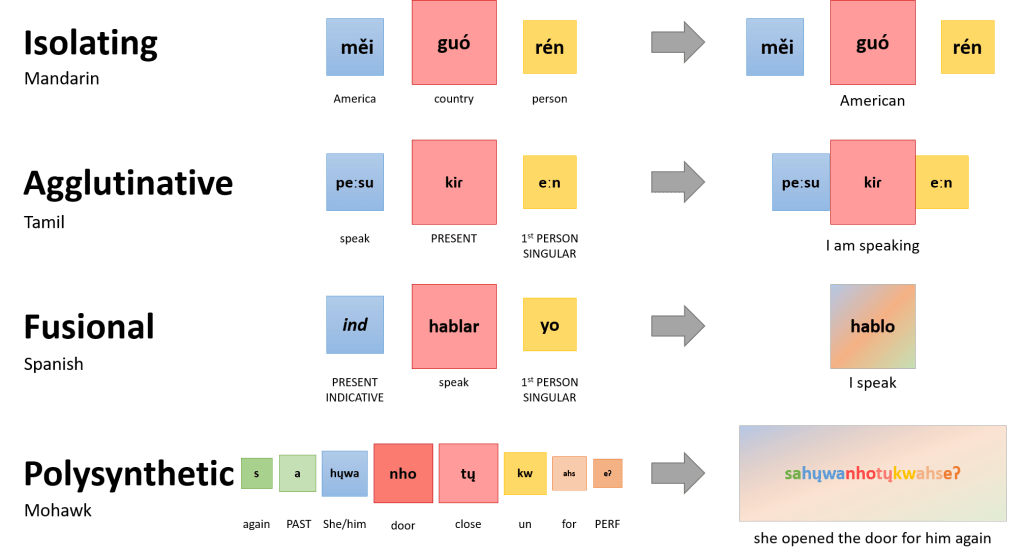
The following illustrations can be found in Chapter 3.3 “Morphology of Different Languages” by Dinesh Ramoo from his book Psychology of Language (2021). I think these illustrations do a good job of visually showing the differences in word formation between isolating, agglutinative, fusional, and polysynthetic languages.
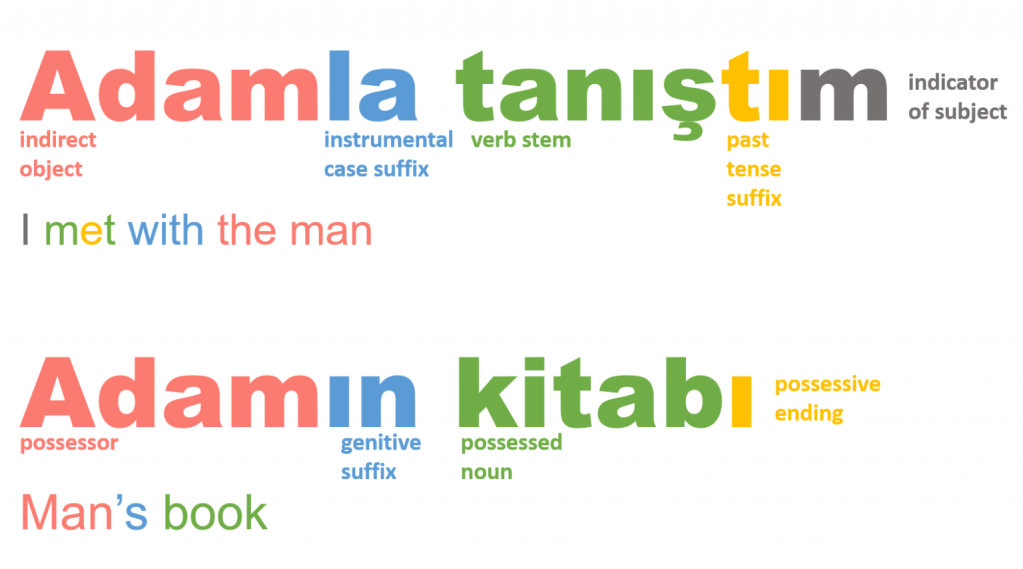
The next image, from the same chapter, shows how two phrases, “I met with the man,” and “Man’s book,” are said in Turkish. Focusing on just the first phrase, the color coding shows us how some of the grammatical information – for example, past tense – is fully incorporated into the Turkish word “tanıştım”. The same is true in English, where “met” shows us past tense, as opposed to the present tense “meet”. However, the Turkish suffix “-la” is doing the job of the English standalone word “with.” For a Turkish speaker learning English, it may not be intuitive that “with” needs to be written as a separate word. The same is true in reverse for an English speaker learning Turkish. There very well may be no good answer to the question, “How do you say ‘with’ in Turkish?” At least not in any way that would correspond one-to-one with English.
Illustrations such as these really help to show the different ways languages create their words and support some of the points I was trying to describe in yesterday’s post. I was going to say that the next post will be the last one on grammar, but I should probably stop promising that!
References
- Ramoo, D. (2021). Psychology of Language. Copyright © 2021 by Dinesh Ramoo. Licensed under a Creative Commons Attribution 4.0 International License, except where otherwise noted. https://opentextbc.ca/psyclanguage/



 What Makes a Word?
Leave a comment