Hey, wait a minute. Wasn’t this blog supposed to be a chronicle of your capstone project for a master of arts degree in literacy education? Seems like we’ve gotten off-track a bit with all this linguistics stuff. This isn’t a language blog. “Au contraire!” I would reply (to myself, apparently). Pretty difficult to be literate without language, wouldn’t you say?
Honestly, I’m coming to the conclusion that literacy teachers need even more of a background in linguistics. Why aren’t we collaborating with and learning from ELL teachers more often? Why aren’t we doing deep-dives into what makes language tick? One reason I appreciate all the research I’ve done into linguistics is that I feel it is genuinely making me a better teacher of English, which is, after all, the language of instruction I use every day in the classroom and the language my students use, as well. It’s easy to overlook the language itself when you’re immersed in it all day long and take it for granted, but not all aspects of language are universal, including words.
The question driving my capstone project is: How does morphology work in the Somali and Hmong languages and how can teachers use this knowledge to inform best practices for teaching morphology to Somali- and Hmong-speaking students? Morphology is the study of the internal structure of words, which leads to the question: “What, exactly, is a word?”
No, I’m not just being Socratic to pose some sort of impossible rhetorical question. Defining a word can be tricky, so let’s jump in! Words include: “me,” “you,” “geometry,” “ibex,” “corpulent,” “a,” “an,” “the,” “abruptly,” “six,” “slam dunk” “shameful,” “thou,” “might,” “Anglo-Saxon” and yes, even “rizz,” and “skibidi.” And don’t let anyone tell you that “ain’t ain’t a word.” Contrary to the opinion of some old-school English teachers, “ain’t” is 100% a word.
Words don’t have to be “proper” and appear in the dictionary, as is the case for many slang words and newer terminology. They don’t have to have a long history or be spoken by many people.
Words don’t have to have pauses around them when said out loud. When I say, “How’s it going?” my speech will sound more like, “Howzigoin?” The same is true for “dunno,” instead of “I don’t know.” The only reason you hear these phrases as strings of words and not just a blob of sound is that you know where the spaces are in their written form. Not all languages have a written form, however.
Furthermore, words don’t have to be demarcated by spaces on either side of them, even in print. The word “hot dog” is an example of a single word that made up of two smaller words, both of which have their own unique meanings. A hot dog is not the same as a dog which is hot. You know what I mean.
Because it’s hard to pin down an exact explanation for a word, linguists generally don’t. Instead, they talk about morphemes, lexemes, and word forms.
Morphemes are the smallest units of meaning (described in a previous blog post).
Lexemes are the smallest abstract ideas. This is related to the idea of a “lexicon.”
Word forms are all the versions of a lexeme, modified here and there to show grammatical information.
[W]e have to make a distinction between the notion “word” in an abstract sense (lexeme) and the notion “word” in the sense of “concrete word as used in a sentence”. The concrete words walk, walks, walked, and walking can be qualified as word forms of the lexeme WALK.”
Geert Booij (2012). “The Grammar of Words: An Introduction to Linguistic Morphology” (3rd. ed.), p.41
Using Geert Booij’s example above, one lexeme (WALK – the basic idea of putting one idea in front of the other to move forward) has several different word forms: walks, walked, walking, etc. The “-s,” “-ed,” and “-ing” are morphemes.
Another example is how “he,” “him,” and “his” are all word forms of HE. (Lexemes are usually written in small capital letters, but, because that doesn’t appear to be a formatting option for me here, I’m just using regular capital letters.)
On the other hand, “regulate,” “deregulate,” “regulation,” and “deregulation,” are all different lexemes because – although related – they each have different and unique meanings and are different parts of speech. “Regulate” and “deregulate” are verbs. “Regulation” and “deregulation” are nouns. And you can’t just switch the former for the latter and maintain the same meaning of your sentence. For example, “Greenpeace has called for further deregulation of the fishing industry,”doesnot particularly make sense.
There are different categories of words and morphemes which overlap with each other. Here’s a quick summary based in part off Park-Johnson & Shin, 2020, pages 57-61:
Content (Lexical) Morphemes vs. Function Morphemes
Content morphemes (aka: lexical morphemes) tell us about meaning and ideas, including parts of speech.
Examples of content morphemes are: “love,” “realize,” “elephant,” “-tion,” “dis-” and “un-“.
Function morphemes give us grammatical information.
Examples of function morphemes are: “a,” “and,” “but,” “-ing,” “-s,” and “-ed”.
Free Morphemes vs. Bound Morphemes
Free morphemes can stand by themselves.
Examples of free morphemes from the previous lists are: “love,” “realize,” “elephant,” “a,” “and,” and “but”.
Bound morphemes cannot stand by themselves and must attach to other morphemes.
Examples of bound morphemes from the previous lists are: “-tion,” “dis-,” “un-,” “-ing,” “-s,” and “-ed”.
Bound roots, such as the “cran” in “cranberry” and the “reck” in “reckless” also fall into this cateogry.
Open Class Morphemes vs. Closed Class Morphemes
The open class of morphemes is flexible and open to change. These usually include nouns, verbs, adjectives, adverbs. The word “rizz” has recently come into common use among younger English-speaking people. As a millenial, I’m not entirely sure if “rizz” would be best classified as a noun, verb, or adjective, but I know it’s definitely one of those three, so it falls into the open class. These words can come and go in our vocabularies.
All content (lexical) morphemes are in the open class.
Examples of open class morphemes are: “temple,” “typewriter,” “sushi,” “bougie,” “dictionary,” and of course, “rizz”.
The closed class of morphemes is not flexible and generally does not accept new additions. These are the workhorses of language, and usually include articles, conjunctions, prepositions, and pronouns.
All function morphemes are in the closed class.
It’s important to note that the so-called “closed” class isn’t completely closed. A good example is the recent mainstream acceptance of singular they as a grammatically correct pronoun. And, of course (speaking of pronouns,) we used to have “thee,” and “thou,” in English, even though they are no longer in common use.
Examples of closed class morphemes are: “this,” “she,” “however,” “-ed,” “-er,” and “-est.”
content morphemes
function morphemes
free morphemes
table, book, green, Covid
open classwith frequent additions from evolving slang, new technology, and loanwords from other languages
the, and, on, you
closed class with rare changes, for example the mainstream usage of singular they
bound morphemes
affixes: pre-, mis-, -ish, -ly and bound roots: the cran in cranberry
open class, but much less likely to take on new additions compared to free morphemes
used in derivational morphology
-s, -es, -ed, -ing
closed class, comprising of grammatical markers, such as those that show number or tense
used in inflectional morphology
Simple Words vs. Complex Words
Simple words contain only one morpheme and cannot be further reduced into meaningful parts.
Examples of simple words are: “happy,” “jog,” “rabbit,” “trombone,” “bridge,” and “calculate”.
Complex words contain multiple morphemes.
Examples of complex words are: “uninhabited,” “seasonal,” “misunderstanding,” “insufferable,” “shiniest,” and “authorship.”
Roots vs. Affixes
Roots are the heart of a word. They tell the main idea or “semantic content” (Park-Johnson & Shin, 2020, pg. 57) of a word. In English, roots are usually free content morphemes, but a few are also bound content morphemes.
Examples of roots are: “table,” “heart,” “sing,” the “gruntle” in “disgruntled” the “whelm” in “overwhelmed,” and the “huckle” in “huckleberry.”
Affixes are added on to a root to give more information. Although we mostly think of prefixes, which come before a root, and suffixes, which come after a root, infixes and circumfixes also exist.
A prefix comes before a root.
Examples of prefixes are: “anti-,” “dis-,” “un-,” “fore,” “non-” and “pre-“.
A suffixes comes after a root.
Examples of suffixes are: “-ship,” “-ness,” “-tion,” “-ly,” “-er,” and “-est.”
Infixes are placed in the middle of a root.
Examples of infixes are the “frick” in “fan-fricking-tastic” or the “bloody” in “abso-bloody-lutely.”
Circumfixes are placed around a root.
Examples of circumfixes are the “em-/-en” in “embolden,” or “en-/-en” in “enlighten.”
Derivational Morphemes vs. Inflectional Morphemes
Derivational morphemes change the meaning or part of speech of root.
Bound content affixes such as “-ship” and “fore-” are derivational.
They can be prefixes, as in the word “foreground,” or suffixes, as in the word “friendship.”
Inflectional morphemes add grammatical information to a root.
Bound function affixes like “-ed,” “-ing,” “-er,” and “-est” are inflectional.
They perform a grammatical function, such as telling us if a verb is in the past or present, or telling us if a noun is singular or plural.
In English, all inflectional morphemes are suffixes, coming after the root. There are only about eight of them total in English.
What is a word? What does it mean when we say we know a word? Knowing a word means knowing both its sounds and its meaning. Every speaker of English knows that “measure” is an English word, as are “measurement,” “measuring,” and “immeasurable.” However, even though “street” is an English word, English speakers know that they cannot say any of the following: “streetment,” “streeting,” “streetable,” “instreetable.” How do English speakers know that adding “-able” to “measure” results in another word, but adding “-able” to “street” does not? Morphology tries to capture this knowledge, which is largely subconscious.
Sunny K. Park-Johnson and Sarah J. Shin (2020). “Linguistics for Language Teachers: Lessons for Classroom Practice,” p. 56.
Reading this quote makes me think about the question I posed in my second blog post: “How come you can be joyful but not happy-ful?” At the end of that post I mused that the answer might be because “joy” is a noun and you can have lots of (i.e. be full of) a noun, but you can’t do the same for an adjective, such as “happy.” This seems to parallel the “measurable”/”streeable” example pointed out by Park-Johnson and Shin. Like they say, however, these things are often subconscious and, therefore, not easy to articulate.
Unless we are trying to emulate the prose of James Joyce, “happyful” and “streeable” are not good choices for everyday writing. I actually love the creativity and inventiveness of “words” such as these, but alas, that is not the focus of this blog, nor the goal of my research question.
So why care about words? Because, as Park-Johnson and Shin write, “Quite simply, words are the building blocks of communication” (2002, p. 56). Languages treat words in very different ways that aren’t necessarily intuitive to speakers of other languages. Let’s talk about some of that variation.
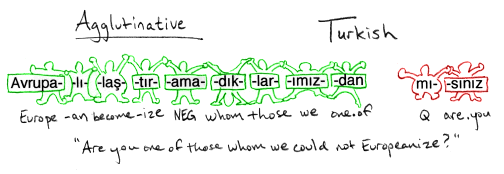
On one end of the spectrum, languages such as Chinese, Vietnamese, and Yoruba have an almost 1:1 morpheme-to-word ratio. These are called isolating languages, a concept closely related to analytic languages. On the other end of the spectrum, synthetic languages such as Turkish, Finnish, and Yup’ik have a high morpheme-to-word ratio. In synthetic languages, single words may be 20 letters long, or longer, and contain many, many pieces of relevant information.
Languages can also vary in how much, or how little, they fuse their morphemes together. In highly fusional languages, such as Spanish or Polish, a single morpheme might communicate multiple grammatical ideas, such as gender and number. Grammar markings fuse into one multifunctional word form. In other languages, such as Turkish or German, each bit of grammatical information gets tacked on to the end of what often ends up being a pretty long word. It’s almost as if each morpheme gets glued to the final word form. This is called agglutination, and yes, the etymology of this words means “glued together.”
English is much more isolating than synthetic, but we do have our examples of long words with multiple chunks of meaning “glued” together. Perhaps the most famous example is “antidisestablishmentarianism,” a word mostly know for its length. I count six morphemes: anti/dis/establish/ment/arian/ism. That’s a lot for English! Usually by the time we reach six morphemes, English has decided to just break a word apart into a couple of smaller words. This wouldn’t be the case in, say, Turkish where you just keep throwing morphemes on to the end of a growing word. Agglutnative languages have a “the more the merrier” attitude when it comes to incorporating morphemes into words, and each morpheme gets to keep its own space in the word, too. Very generous.
These illustrations from Speculative Grammarian do a great job of showing the difference in how languages use their words to build meaning. I can’t personally vouch for these translations, but this was re-posted by Gretchen McCulloch on her blog All Things Linguistic, a source I trust.
Speaking of Gretchen McCulloch, a linguist I really admire, she collaborated with YouTuber and public educator Tom Scott to produce a wonderful series on linguistics. Below is their video on this topic. The descriptions of the terms “isolating,” “agglutinative,” “fusional,” and “polysynthetic” might be slightly different than how I’ve described them above. I’m only an amateur linguistics enthusiast, so please defer to Gretchen, who wrote this episode, when it comes to definitions. (Or, a different professor, a textbook, or anything more reputable than this one-woman-blog written by an enthusiastic but very tired grad student!)
Let’s leave it there for now. The next blog post will be the last in the mini-series on what I discovered down the linguistics and grammar rabbit-hole. After that, I will shift my attention to more practical educational applications for all this knowledge.
References
Booij, G. (2012). The grammar of words: An introduction to linguistic morphology (3rd ed.). Oxford University Press.
Park-Johnson, S. K. & Shin, S. J. (2020). Linguistics for language teachers: Lessons for classroom practice. Routledge.
Hornsby, D. (2014). Linguistics: A complete introduction. Teach Yourself.
Due to formatting constraints in Word Press, the use of italics, bold, and quotations marks is slightly different in both the Booij and Park-Johnson & Shin quotes compared to their original source material. ↩︎
Let’s Learn How Words Work in Different Languages.
What does morphology look like in different languages and how can educators use this information to best teach their English Language Learners?
Hello, I’m Danna. Welcome to my blog! An educator based in St. Paul, Minnesota, I’ve been teaching since 2011 and have taught literacy skills since 2021.
I have been around for the rise and fall of Lucy Calkins (I still think the “Units of Study” are great for teaching certain reading skills – just now how to read) and I fell into literacy education around the time that the Science of Reading was beginning its renaissance.
I’ve been working on my Master of Arts in Literacy Education from Hamline University in St. Paul from 2023-2025. As part of my capstone project, I am exploring how morphology (the internal structure of words) functions in other languages. I want to know how insights into our students’ diverse home languages can help us improve our best practices for teaching English Language Learners.
In particular, I want to learn more about Somali and Hmong. These two languages represent the 2nd and 3rd most commonly spoken home languages of Minnesota students, but they receive far less attention and support than Spanish, a language much more closely related to English and often more familiar to English-speaking teachers.
Join me as I learn what makes a word work in English, Somali, Hmong, and maybe some other languages, too!






 What Makes a Word?
Leave a comment