A fascinating thing happened in my 5th grade class today and I would be remiss if I didn’t stop for a quick retelling.
Our school uses the Louisiana Literacy FIRE (Foundational Instruction for Reading Excellence) program and Lesson 2 of Unit 1 is centered on the suffix “fore.” Suffixes? Roots? Morphology? Now this is my wheelhouse.
Although earlier in the day the unthinkable had happened and a student accidentally knocked over my big old cup of water onto my laptop, effectively killing it (I’m writing this on my fiancé’s computer) not even this disaster could keep me down when we got to our morphology lesson. What can I say? It’s my “special interest,” so to speak.
I asked students to brainstorm words that have “fore” in them. We ended up eight words total:
- forehead
- forearm
- forest
- before
- foreshadow
- foresee
- forewarn
- forecast
I was secretly delighted that “forest” came up because it was a perfect non-example, suggested by a Karen-speaking ELL student. Yes, it has the spelling of “fore” in it (as well as “for,” “or,” “ore,” and “rest,” as another student pointed out) but it’s not quite in the same category as the other words. A different student raised their hand to point this out, seemingly concerned that I had made a mistake by including “forest” on the list. Oh no – no mistake at all! You’ve simply jumped ahead and seen the anomaly I was about to point out. Why is “forest” unlike the others?
After a “turn and talk” students were able to share two main reasons why “forest” wasn’t like the other words on the list. First, students could tell there was a meaning of “before,” “ahead of,” or “in front” associated with all the others. Your forehead is in the front of your head. You foresee something before it actually happens. You forecast tomorrow’s weather, not yesterday’s.
Second, in every other instance, you can separate the “fore” from the rest word and you’ll be left with a smaller word that still makes sense. You can remove the “fore” from “forearm” and you’ll be left with “arm,” which is a full word and concept in its own right. Same with be/fore, fore/shadow or fore/warn. When you isolate the “fore” in “forest” you’re left with “st,” which is… nothing.
(“St” isn’t a word I told the students, taking care to pronounce it as a sound and not just the letter names. “What about ‘street’?” one student asked. Kids are clever. I never cease to be amazed by the creativity of their varied viewpoints. We addressed the “St.”/”street” confusion and moved on.)
Fore = In font I wrote on the whiteboard, and asked students to copy this into their own notebooks. This was the crux of the lesson, after all.
At this point, a student – let’s call them Riley- asked me a question that blew me away.
Riley said, “What about ‘before’? If ‘fore’ means ‘in front’ then why do we say ‘before’ for something that already happened?” I’m not entirely sure if they realized the depth of what they were asking, but maybe they did. Not only are kids clever, they can often be more insightful than you’d think. Riley was asking why, in the passage of time, the earlier event is “in front” of later events. From the vantage point of the present, past events don’t intuitively seem like they’re in front of us, even if they happened first.
In truth, there is no empirical reason why events of the past are stationed “before” or “in front” of the present or future.
I drew this picture on the whiteboard. (Unfortunately, I erased it so I’ve had to recreate it, with pseudonym, on the back of an envelope.) At the time of the lesson, we had already had recess but P.E. was still upcoming.
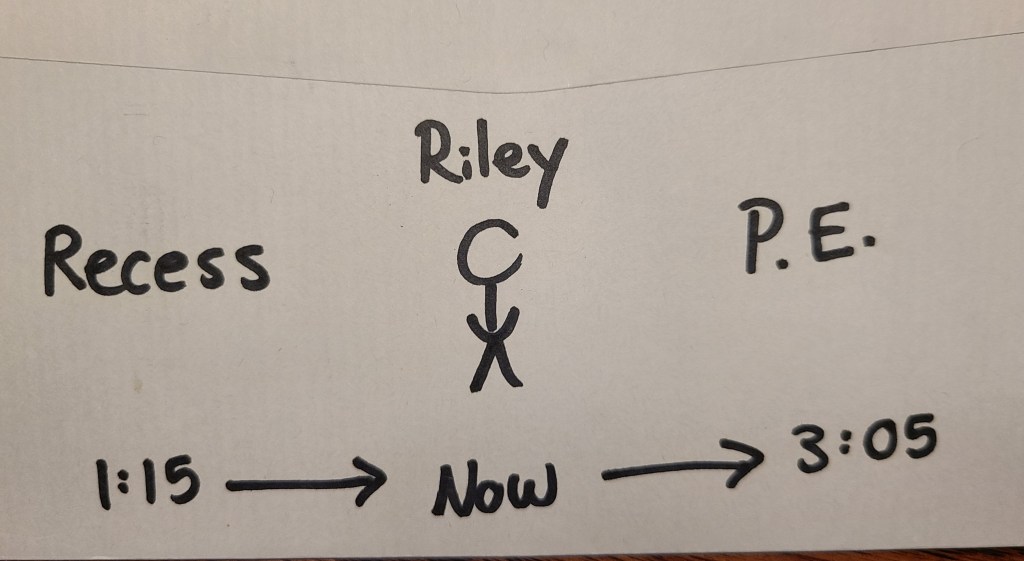
I told Riley, and the class, that in Western culture we usually see events as coming toward us. That, or we see ourselves as advancing toward events. Those which happen first are “before” or “in front” of others on some sort of imaginary linear path (i.e. timeline).
We use a spatial metaphor to visualize the passage of time and the march of events, and – at least in English – we think of our timelines as going from left to right, as in the drawing above. (Do Hebrew and Arabic speakers draw their timelines from right to left? Do Chinese and Mongolian speakers make theirs vertical?)
When describing the whole thing to Brain (said fiancé) he made a great point that this visual metaphor also extends to ships. (And English loves nothing if not a nautical metaphor.) You face the “fore” or a ship while your back is to its “aft.” There’s nothing predestined about how your stand on a ship, but that’s the metaphor we use to position ourselves in space, and, as it turns out, time. At least that’s the metaphor we use in English.
It’s fascinating to think about. Is the future coming toward us? Or, are we facing the future as it passes us by? Is the past in our wake? (Another nautical metaphor.) Or is it in front of us on a flattened 2D timeline?
The reason I believe it’s worth posting about is because although morphology is meant to illuminate the meaning of words, it is really only useful to our students if they understand the linguistic metaphors that underpin them. This is a very big assumption and one we shouldn’t automatically make, regardless of students’ home languages or cultures.
Time, space, good, evil, growth, love, war, danger: these are all concepts that get woven into our linguistic metaphors, some of which are so deep that they go beyond phrases and can be found at the level of sub-word morphemes. As George Lakoff and Mark Johnson wrote, the “metaphors we live by” often go unnoticed in our everyday lives but they absolutely color the language we use and the ways we imagine our world.
To throw out yet another metaphor, it’s certainly food for thought. (Actually, that’s two metaphors, isn’t it? “Throwing” is a metaphor for how I am sharing my ideas and “food” is a metaphor for the ideas themselves. It’s turtles all the way down. Ok, I’ll stop.)



 What Makes a Word?
Leave a comment