
It’s been a while since I checked in and I apologize for that. Summer school wrapped up in late July and then I got to enjoy a wonderful couple weeks of vacation with my fiancé and his family in Ocean City, Maryland – all the while, still reading articles and adding paragraphs and pages onto my capstone rough draft. In the process, this blog got rather overlooked. When we returned from vacation, it was straight to opening week at school and classroom prep. (In addition to wrapping up the master’s degree, I’m a new 5th grade teacher. This, after having not had my own classroom in five years. Pray for me.)
One of the reasons I didn’t update the blog is that it was difficult to access from the depths of the research rabbit hole I found myself in. I’ve spent a good amount of time in this rabbit hole now – more than I should have – and I’ve become quite familiar with the surroundings. Let me tell you all about it.
I was supposed to be researching how linguistics can support literacy learning. Instead, I began with the linguistics part and just kept going. Honestly? No regrets. Linguistics is a passion of mine and a big part of why I chose to focus on language for my capstone in the first place. (The capstone topic, if you recall, is: How does morphology work in the Somali and Hmong languages and how can teachers use this knowledge to inform best practices for teaching morphology to Somali- and Hmong-speaking students?)
So far, I haven’t learned much about the Somali and Hmong languages, but I have learned a ton about English grammar. After all – I figured – in order to understand how morphology works in other languages, I need to understand how it works in my native language first.
Reading books such as Haspelmath and Sims’ Understanding Morphology (2010) or Geert Booij’s The Grammar of Words: An Introduction to Linguistic Morphology (2012), I plunged right into the deep end. At least it felt that way from my amateur’s perspective. I was now in the territory of “books written for people actually studying linguistics” and no longer in “here’s what you need to know as an educator” territory.
Up until this point, morphology had been almost synonymous, for me, with teaching lists of Greek and Latin roots, along with some common suffixes like “-tion” and “-ly.” So when I started digging into the subject, I was surprised (not to mention fairly overwhelmed) by the deluge of information I was suddenly making my way through. Turns out there’s a lot more to morphology than knowing your Greek and Latin prefixes. Recognizing that the “dem-” in “democracy” means “people” is just the tip of the iceberg.
The first thing I had to learn was the difference between inflectional and derivational morphology. Already we’re into the technical terms. But hold on! Let’s pause and back up. The word “morphology” itself needs an explanation, so before going any further, let’s define it.
Morphology is the branch of linguistics that studies the smallest meaningful parts words. Or, if you’re being fancy, “the internal structure of words.”1 Some words represent only one concept, but others have multiple concepts or bits of grammar embedded in them, all wrapped in one word. Morphology breaks down words into their constituent, meaningful parts. One chunk of meaning equals one morpheme. I don’t know if this is really the right metaphor because I haven’t studied chemistry since high school, but I think of those tiny, individual bits of meaning (morphemes) like atoms and the words they form as molecules. You can have hydrogen and you can have oxygen, but water is its own unique thing, even though you can clearly tell where each part of the molecule came from. You can do the same thing with something as simple as the words “cat” and “cats.”
The word “cat” has one morpheme: the only concept here is a furry little feline. “Cats,” however, has two morphemes. The “-s” at the end of the word tells us we’re talking about more than one cat. Something as small as just the letter “-s” can be a morpheme. Sticking with the animal theme, “elephant” has one morpheme (elephant) and “zoologist” has three: zoo/olog/ist (animal/study-of/do-er). You have now received an extremely barebones overview of what morphology is.
(Disclaimer: I’m not an expert in linguistics, just a nerd who loves words and is posting her learning process online. If I’ve messed up or misconstrued anything, please forgive these as good-faith mistakes. Also, don’t learn linguistics from a random stranger online. If you’re interested in going on your own linguistics-learning journey, I recommend this great resource I came across: Essentials of Linguistics, 2nd edition. This entirely free, full-length textbook was written by several linguistics professors at different Canadian universities and is published by the authors themselves through Creative Commons. Also, I can’t recommend the podcast Lingthusiasm enough. It is such a joy!)
When I started my research into morphology, I found it almost impossible to write about without going into lots of background information first. I was front-loading way too much information into my capstone paper. The more I learned about the subject, the harder it was for me to discuss it without getting wrapped up in ten tangents and a dozen definitions. There was so much to know!
You know that “learning pit” graphic?2 Over the past two months I found myself going down, down, down the pit. I was thinking, “I’ve got to get to the bottom of the linguistic morphology pit before I start learning about how it applies to education.” This was a mistake. The pit was (is) deeper than I ever knew. I didn’t set out to teach myself all about English grammar, but that’s what happened. The thing about the learning pit is you don’t always know where it’s taking you. In fact, you rarely do. And here we are.
Ok. So.
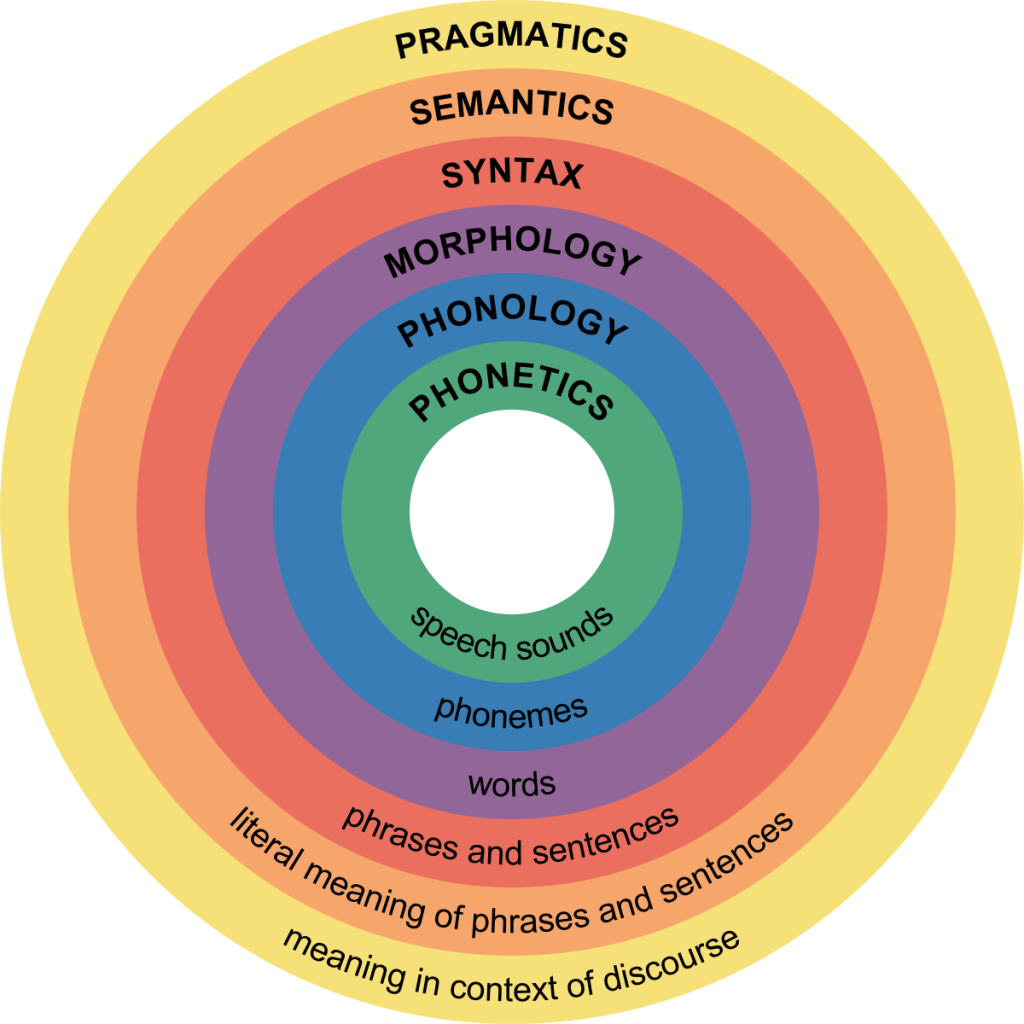
Linguistics is the scientific study of language, which is complex and includes several different parts. Imagine a circle with concentric rings. (Actually, you don’t have to imagine it because this image is in the public domain and I can post it here.) Each ring shows a step up in the scale of what’s being studied, starting from the tiniest, discrete, meaningful sounds our human voices can make (phonetics), all the way up to how people communicate in context (pragmatics). In the middle of this scale is the study of words (morphology).
As I mentioned, the first big conceptual hurdle for me was wrapping my head around derivational versus inflectional morphology. Derivation changes the meaning of a word or its part of speech. For example, changing “respect” to “respectful,” and then again to “respectfully” (or “disrespectfully,” if I want to show the opposite meaning). Those Greek and Latin roots, by the way, all fall into the derivational category. English is rich in derivational morphology in no small part because of Greek, Latin, and French influence on the language over the millennia. Inflection, on the other hand, marks up words to show grammatical information. For example, how the “-s” on the end of “cats,” shows plurality, or how I would say, “I listen to music,” and “you listen to music,” but “he listens to music.” In this case, we tack an “-s” on to the end of “listen” to make “listens”, but for entirely different reasons than we did for “cat/s.”
From there, the subcategories and applications get more nuanced. We haven’t even talked about all the different kinds of morphemes yet! But I’ll leave that for another day. We don’t have to go all the way down the rabbit hole all in one go.
- This is a very common definition of morphology. This exact wording can be found in: Haspelmath & Simms (2010), Understanding morphology (2nd ed.), p. 1; Park-Johnson & Shin (2020), Linguistics for language teachers, p. 56; and Booij (2012), The grammar of words: An introduction to linguistic morphology (3rd ed.), p. 7. ↩︎
- Created and copyrighted by James Nottingham. Visit learningpit.org to learn more about the graphic and the ideas behind it. I am using the concept of “the learning pit” in very general terms and do not claim to represent the specifics of James Nottingham’s concepts, pedagogy, or professional development. ↩︎




 What Makes a Word?

Leave a comment